

1812 Marie Philippine Krückeberg Marriage#
Family Relationship and Other Facts#
Name |
Address (at time of marriage) |
Age |
Religion |
|
|---|---|---|---|---|
Groom |
Friedrich Wilhelm Raulfing |
No. 13 Bärenbusch (assumed. See note) |
23 |
Lutheran |
Bride |
Maria Philippine Krückeberg |
no. 10 Bärenbusch (assumed. See Note) |
18 |
Lutheran |
Groom’s Father |
Albert Raulfing (deceased) |
No. 13 Bärenbusch |
||
Bride’s Father |
Johann Heinrich Krückeberg |
10 in Bärenbusch |
Note
In 19th-century German church records:
Individuals were often identified by village and house number associated with the head of household — usually the father.
This applied to both deceased and living fathers, and often included professions (like “Leibzüchter”) or inheritance status (like “Anerbe”).
Even if the son or daughter still lived at that house, the address is still formally associated with the father in these records.
Birth |
Death |
|---|---|
13 July 1788 |
5 Dec. 1859 |
Birth |
Death |
|---|---|
1794 in Steinbergen |
14 Feb. 1866 |
Name |
Status |
Address |
|---|---|---|
Albert Raulfing |
Deceased |
no. 13 Bärenbusch |
Name |
Address |
Status |
|---|---|---|
Johann Heinrich Krückeberg |
10 in Bärenbusch |
Pensioner allowed to live on the property |
Record#
The marriage record is on image 27, on pages 48 and 49 of Petzen Kirchenbuch: Verzeichnis der Getauften, Konfirmierten, Getrauten und Gestorbenen 1785-1827.
Pages 48 and 49#
Page 48 portion:
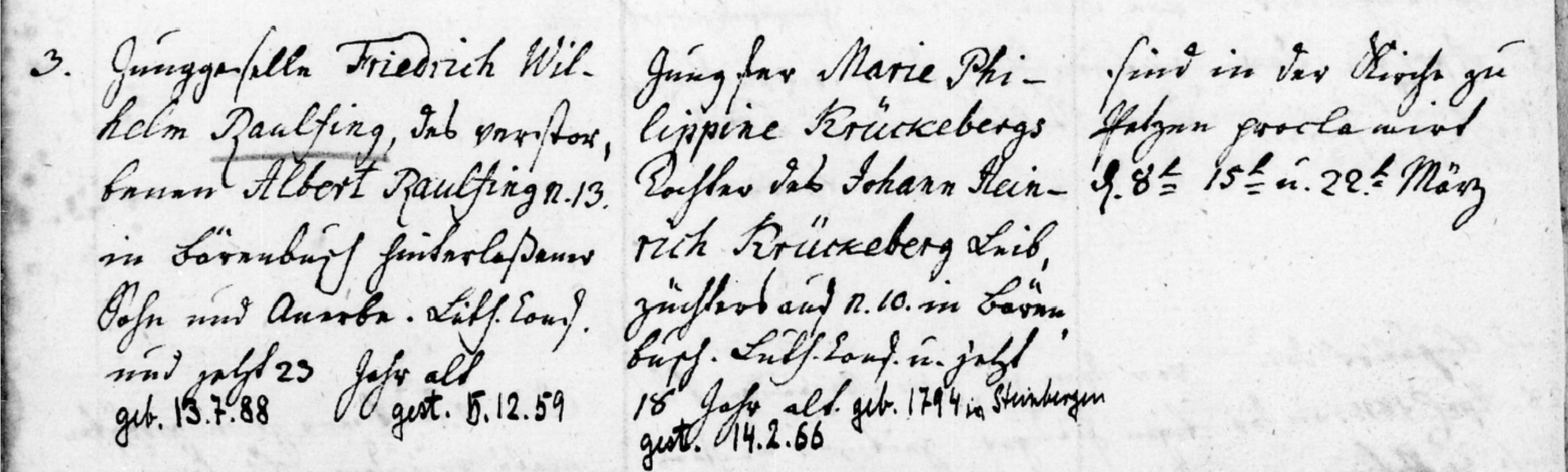
Page 49 portion:

Note
hinterlassen — is a verb meaning: to leave something to somebody, to bequesth something, to leave somebody a legacy of something; to leave hind. As an adjective is can mean “bereaved” or “survivor (of someone deceased)”. hinterlassener would be the adjective form used for a male survior: ein hinterlassener Sohn (a surviving son).
Anerbe — is defined in dict.cc as:
principal heir[to a landed estate]
single heir. Anerbe comes from Anerbenrecht, which is: “inheritance law keeping farms intact (in northern Germany and old Bavaria).” — from Thode’s German-English Genealogical Dictionary Chatgpt explained how Anerbenrecht operated in Schaumburg-Lippe:
In 1826, in Schaumburg-Lippe, “Anerbe” had a specific legal and social meaning rooted in German inheritance practices. Here’s what it meant in your context:
Anerbe refers to the designated heir (often the eldest son, but not always) who inherits the entire farm or family estate.
This was part of the tradition of Anerbenrecht (hereditary right of succession), which was common in rural parts of Germany, especially in northern and central regions like Schaumburg-Lippe.
Instead of dividing property among all children (which would fragment farms into uselessly small plots), one heir (the “Anerbe”) would inherit the main estate to keep it intact. Other siblings were typically given monetary settlements or other smaller arrangements (“Abfindung”).
The Anerbe took on responsibility for supporting aging parents and sometimes helping siblings until they could establish themselves elsewhere.
In a Kirchenbuch entry, if someone is called an “Anerbe,” it likely signals that:
He was the successor to a farmstead or property.
He had a certain social and financial standing in the village.
His status could affect marriage prospects, taxes, and legal responsibilities.
Benner — Thode’s defines this as: cooper.
Leibzüchtner(male)/Leibzüchtnerin(female) — Thode’s definition is: “person on life estate”. He defines Leibzucht as: “life annuity; pension; life estate”. See this more detailed explantion: What is a Lieftucht/Leibzucht?.
Zahl |
Name, Stand, Religion und Eltern des Bräutigams |
Name, Religion Geburts u. Wohnort der Braut |
Zeit und Ort der Proclamation |
Zeit u. Ort der Kopulation |
der kopu lirende Prädiger |
Kopulations Zeugen |
Bemerkungen |
|---|---|---|---|---|---|---|---|
Junggeselle Friedrich Wil- helm Raulfing, [Sohn] des verstor- benen Albert Raulfing n. 13 in Bärenbusch hinlerlaßener Sohn und Anerbe Luth. Conf. und jetzt 23 Jahre alt geb. 13.7.88 gestr. 5.12.59 |
Jungfrau Marie Phi- lippine Krückebergs Tochter des Johann Hein- rich Krückeberg Leib züchters aus n.10 in Bären busch. Luth. Conf. u. jetzt 18 Jahr alt. geb. 1794 in Steinbergen gest 14.2.66 |
Sind in der Kirche zu Petzen proclamiert d. 8ten 15ten 28[29?] März |
u. Kopuliert d. 10ten Maÿ |
von dem zeitigen Prädiger Stille |
in Gegenwart der Beichentende des Küster Crömer |
[empty of text] |
No. |
Name, Occupation, Religion, Parents des Bräutigums |
Name, Religion Birthplace and Residence of the Bride |
Time and Place of the Proclamation |
Time and Place of the Marriage |
The offi- ciating Minister |
Marriage Witnesses |
Remarks |
|---|---|---|---|---|---|---|---|
Bachelor Friedrich Wil- helm Raulfing, surviving son and Anerbe of the late Albert Raulfing n. 13 in Bärenbusch. Luth. Conf. and now 23 years old born 7/13/88 died 12/5/59 |
Maiden Marie Phi- lippine Krückeberg daughter of Johann Hein- rich Krückeberg on life estate from.10 in Bären busch. Luth. Conf. and now 18 years old. born. 1794 in Steinbergen died 14.2.66 |
Were announced in the church at Petzen proclamiert d. 8th, 15thn 28th March |
and married the 10th May |
by the current pastor Stille |
in presence of the Confessing and of the parish clerk/sacristan Crömer |
[empty of text] |
Citation#
“Archion Protestant Kirchenbücher Portal”, database with images, Archion (http:.md : 4 October 2023), path: Niedersachsen > Niedersächsisches Landesarchiv > Kirchenbücher der Evangelisch-Lutherischen Landeskirche Schaumburg-Lippe > Petzen > Verzeichnis der Getauften, Konfirmierten, Getrauten und Gestorbenen 1785-1827 > Image 27 of 357