In German archival practice, there is a general term for later-added notes to an ortiginal record of a ceremony: they are called “Nachträge” (singular: Nachtrag), which translates to “addenda” or “later additions.”
In the context of Kirchenbücher (church books), a Nachtrag might include:
A death date added to a baptism or marriage entry (often prefaced with “†” or “gest.” for gestorben)
A confirmation date added to a baptism record
A marriage note added to a baptism record
a baptism date and, when the individual dies, a death date
An emigration note, especially in 19th-century records
Example Marriage Record with Nachträge¶
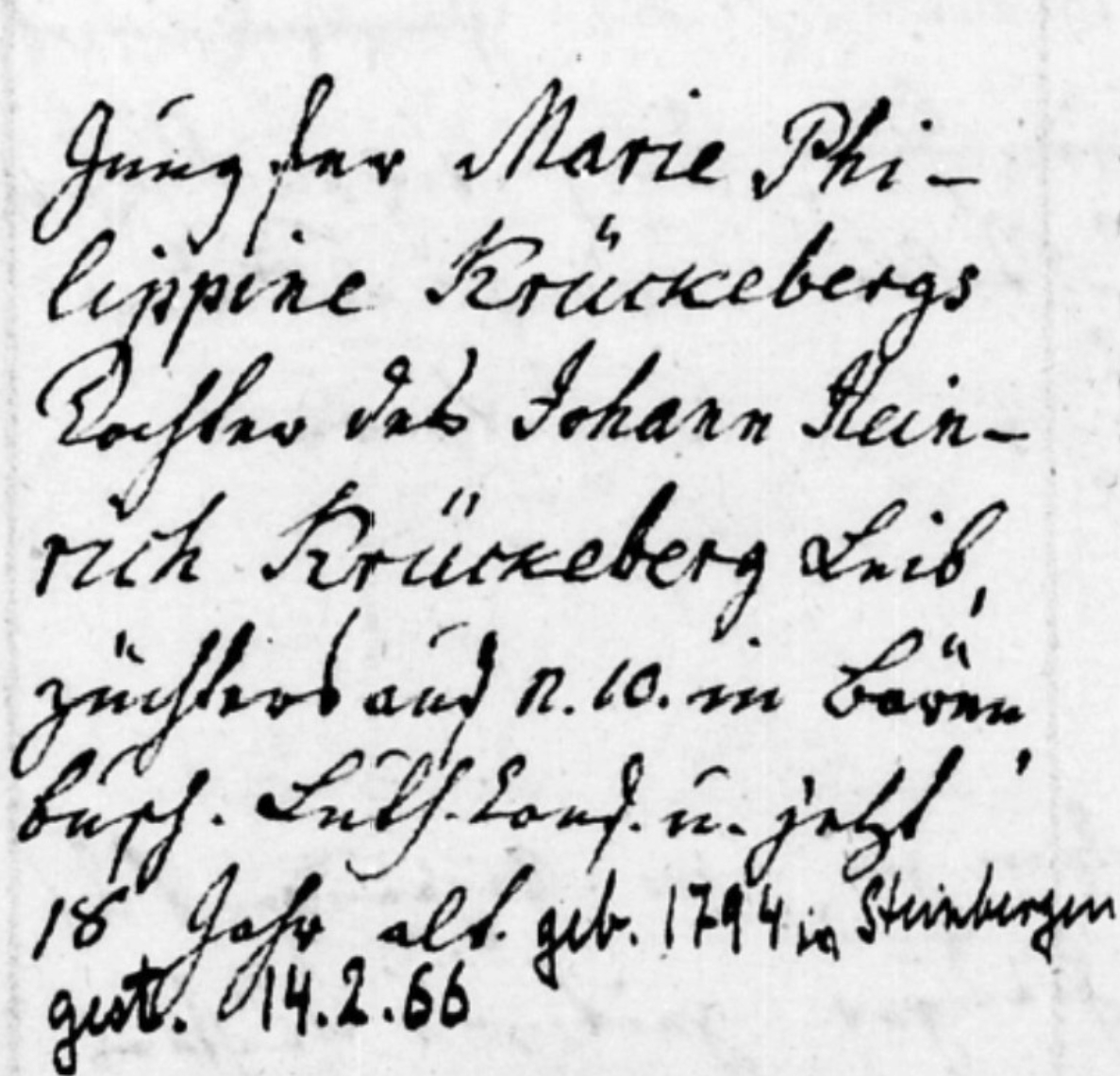
Below is excerpt from a Petzen 1812 marriage record. It shows the column for the name of the bride, Marie Philippine Krückeberg. At the bottom, written in a smaller hand, is still the Nachträge (addendum):
geb[oren]. 1794 in Steinbergen(“born in 1794 in Steinbergen”)gest[orben] 14.2.66(“died on February 14, 1866”).
Example Baptism Record with Nachträge¶
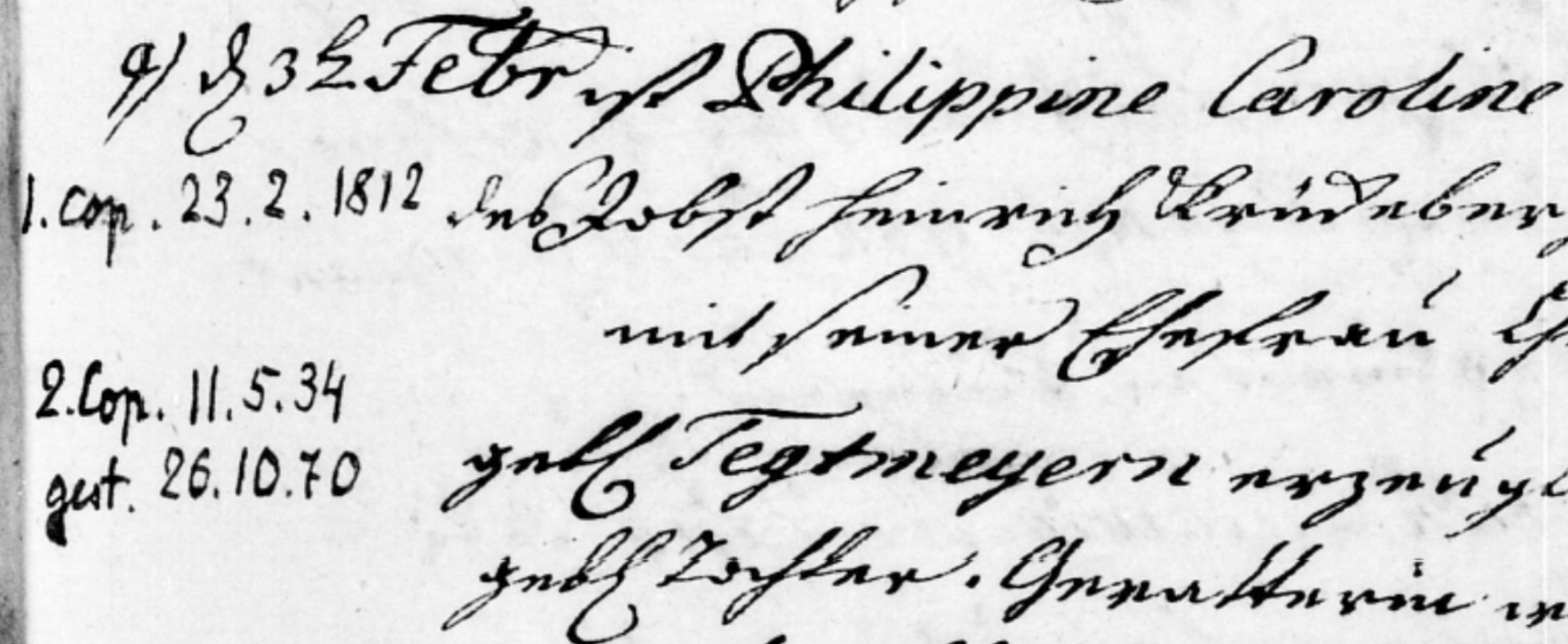
This is excerpt from a Petzen 1792 baptism record for Philippine Caroline Christine Kruckeberg. Written in a smaller hand in the left margin is Nachträge that shows then-future marriages and the date of her death:
1 cop[uliert] 23.2.1812(“First marriage February 2, 1812”)2 cop[uliert] 11.5.34(“Second marriage May 11, 1834”)gest[orben] 26.10.70(“Died on October 26, 1870”)
When Did the Practice of Nachträge Begin?¶
The practice of adding Nachträge (addenda or annotations) began in earnest in the late 18th to early 19th century, although occasional marginal notes appear earlier, particularly in meticulous parishes.
Growth from the 1800s Onward¶
In the early to mid-19th century, especially in Protestant (Lutheran) areas, systematic annotation became more common. Pastors began revisiting earlier entries to cross-reference life events. The introduction of standardized church record formats (1820s–1860s) led to greater detail — and more Nachträge.